


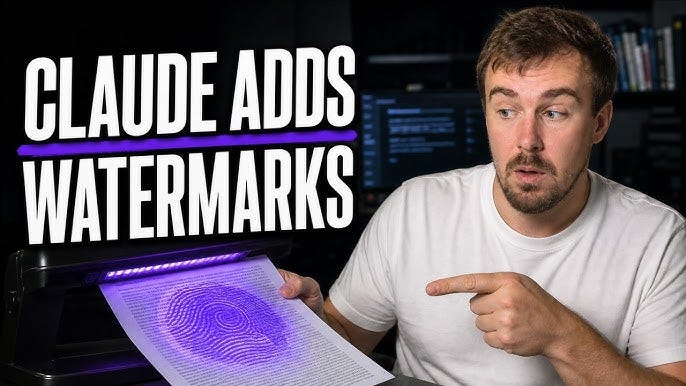
Anthropic is quietly changing how Claude interacts with the internet by weaving invisible watermarks into almost everything it produces. They are doing this largely to comply with the EU’s new AI transparency rules.
This is a big win for accountability because it gives regulators get traceability, platforms get better signals, and institutions get a way to audit AI’s fingerprints in their workflows. But for everyday readers trying to figure out what’s real online, the fact that these watermarks are invisible means the impact will be far more indirect than the headline suggests.
Anthropic’s new policy is straightforward. Any Claude model launched on or after August 2, 2026 now embeds an imperceptible watermark directly into its generated text, and attaches signed provenance metadata to supported file types like SVG, PNG, and JPG.
The change is global, not limited to Europe, and applies across every way you can reach Claude — consumer app, API, Claude Code, Claude Cowork, Claude Tag, and cloud deployments on AWS, Google Cloud, and Microsoft’s Foundry. Older models are in a transition period but are slated to get the same treatment over time.
The text watermark works by subtly biasing Claude’s word choices according to a secret key held by Anthropic, creating a statistical pattern that’s undetectable to human readers but measurable by machines. Anthropic stresses that nothing is actually added to the text — no hidden characters — and that the watermark doesn’t change the meaning, readability, or token count of the response.
Crucially, because it’s baked into the content itself rather than stored as separate metadata, the watermark travels when text is copied and pasted and can survive light to moderate editing. For images and other media, Anthropic is leaning on the C2PA open standard, attaching signed provenance metadata that can specify which model created the file, when it was produced, and whether there are copyright constraints.
That metadata is cryptographically verifiable and designed to make tampering detectable, at least as long as the file keeps its original format and isn’t stripped by conversions or screenshots. Together, these two approaches — statistical text watermarking and C2PA-style metadata — give Anthropic an infrastructure-level way to say Claude touched this without changing how the content looks to humans.
From a policy and platform perspective, that’s powerful. The EU AI Act’s transparency code requires providers to mark AI-generated or edited content in a machine-readable way, and Anthropic is aligning Claude with that standard while several other major labs do something similar.
Anthropic has already signaled that detection tooling, including a text detection API that others can use, is coming so that platforms, educators, and businesses can scan for Claude’s watermark at scale. In other words, this is infrastructure for regulators and large intermediaries to monitor AI’s presence in the content stream.
The tension being caused here is the transparency benefits will show up mostly for institutions, not individual consumers. By design, Claude’s watermark is invisible — you cannot look at a paragraph and see that it’s AI-generated, the way you might see a visible watermark on a stock photo or a Content Credentials badge on an image.
Anthropic is explicit that the difference between watermarked and un-watermarked text will not be distinguishable to readers, and the watermark carries no identifying information about specific users or organizations. So if you’re a student, a casual reader, or someone scrolling a news feed, nothing in your direct experience changes unless a platform chooses to surface those machine-readable signals in the UI.


There are also important limitations which keep this from being a simple truth detector. Anthropic repeatedly emphasizes that a detected watermark is a signal, not proof. This means the text or file may have been processed by Claude at some point, not that Claude originally wrote it.
Users routinely employ models to proofread, summarize, translate, or reformat content that starts out human-authored, which means a watermark could be present even when the underlying ideas and structure are human. On the other side, heavy editing, paraphrasing, translation, or very short passages can weaken or remove the watermark, and file metadata can vanish if you convert formats, edit aggressively, or take screenshots.
Zooming out, this only covers one slice of the generative AI ecosystem. Anthropic, along with OpenAI, Google, Meta, Microsoft, Mistral and many others, has signed the EU Code of Practice on Transparency and is moving toward watermarking as a shared expectation.
But open-source models, smaller providers, and labs outside that framework can still ship systems that produce content with no watermark at all. As long as a significant portion of synthetic media remains unmarked — or marked with weaker, easily removed signals — consumers will still be swimming in a mixed pool of labeled and unlabeled content.
For classrooms, offices, and newsrooms, the practical effect will look less like a magic authenticity stamp and more like another tool in the risk management toolkit. Schools might eventually run assignments through a Claude detection API to flag likely AI involvement, but teachers will still need policies that focus on learning outcomes and integrity rather than treating watermark hits as automatic cheating verdicts. Editors and platforms might integrate provenance checks into their moderation pipelines, but they’ll still have to weigh context and decide if processed by Claude means ghostwritten, lightly edited, or just spell-checked?
Here’s the thing, folks: All of this brings us back to the core paradox. Invisible watermarks are genuinely good for transparency at the system level, yet they don’t directly help most people decide what to trust in their daily reading because they’re not visible in the moment of consumption.
With that . . . The real gains will come if browsers, social platforms, and content management systems start turning those machine-readable signals into visible cues — badges, labels, or provenance panels that users can actually see and interpret. Until that UX layer matures, Anthropic’s move is best understood as foundational wiring for an emerging trust infrastructure, not a finished solution to the “what’s real?” problem that shows up in your feed every day.
Whether you like watermarks or not ultimately does not matter since the ones Anthropic is adding are going to be invisible to the great majority of people.
Please visit Binary News where we post regular opinion pieces about including but not limited to business, politics, sports, and technology.