

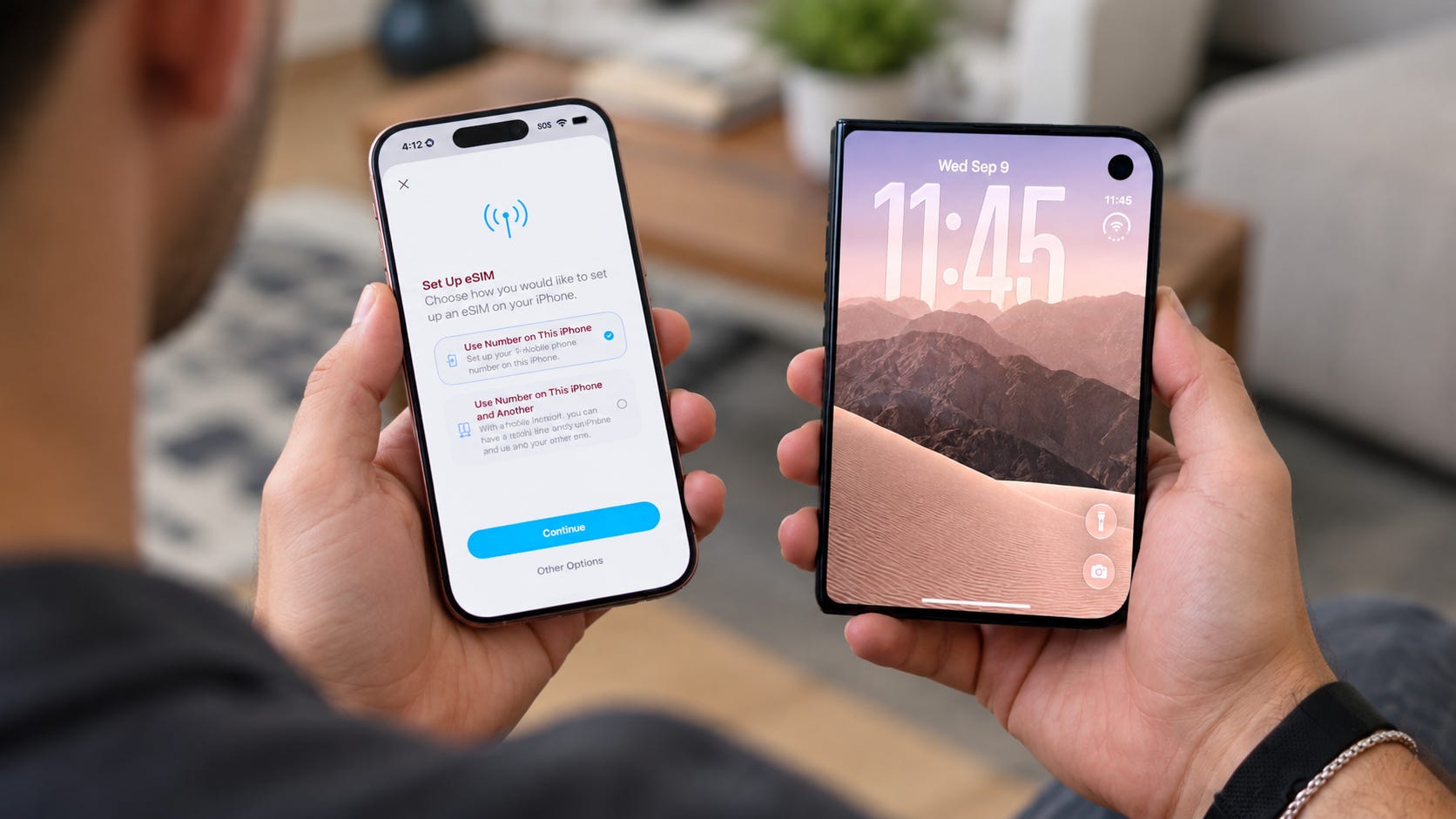
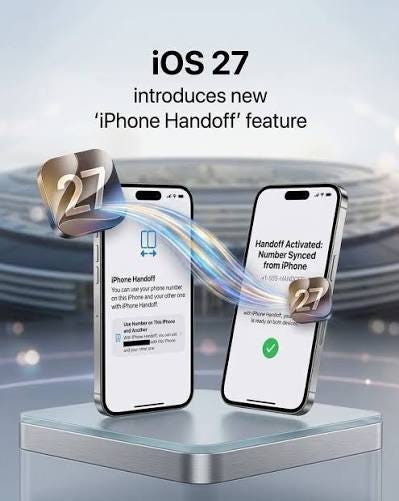
Apple’s new iPhone Handoff feature in iOS 27 may sound like a small convenience, but it could become one of the company’s most practical additions in years. The feature lets someone use the same phone number on two iPhones and move between them simply by unlocking the device they want to use.
Only one iPhone is active on the cellular network at a time, but calls, voicemail, messages and Find My location automatically follow the active phone. Other information stored in iCloud continues to synchronize as usual.
That distinction matters because this is not merely Apple’s familiar Handoff system with a new name. Traditional Handoff lets users begin an activity in an app on one Apple device and continue it on another. The iOS 27 feature effectively hands off the identity and essential communications of the phone itself. Instead of moving only a Safari page, email draft or document, it moves the phone number and the services attached to it.
Google deserves credit for moving Android in a similar direction with Continue On. Android’s feature allows a supported app or task to be transferred between devices so a user can resume where they stopped.
Developers must enable Continue On for each supported activity and provide the state data needed by the receiving device. It is useful continuity, particularly for switching between an Android phone and tablet, and it addresses the annoying process of reopening an app and finding the same screen again.
Apple’s implementation, however, is considerably more useful because it deals with the things that make a phone a phone. When users switch iPhones, their calls and voicemail move with them, as do iMessage conversations and all supported carrier messaging such as RCS, SMS and MMS.
That means the secondary iPhone is not reduced to being a Wi-Fi companion that happens to have the same apps. It becomes the active phone, reachable through the same number and carrying the conversations people expect to find there.
The inclusion of RCS is especially important. Apple could have limited the experience to iMessage and still claimed that messages followed the user, but that would have created an incomplete and frustrating system.
Many conversations include Android users, businesses or automated services, and those threads may arrive through RCS or SMS rather than iMessage. By moving all those messages to the active iPhone, Apple is treating communications as one continuous inbox instead of separating them according to protocol. That is what makes the feature feel complete rather than like another ecosystem demonstration.
This also explains why iPhone Handoff could be more consequential than it initially appears for the new iPhone Duo. Apple’s first foldable will attract buyers who want a larger screen that can open into something closer to a compact tablet.
Yet even people excited about a foldable may not want to carry it everywhere. There will be trips to the gym, quick errands, walks, concerts or evenings out when a smaller conventional iPhone is lighter, simpler and less valuable to risk.
Before iPhone Handoff, a Duo buyer might have traded in an existing iPhone to reduce the cost of upgrading. Keeping the old phone would have meant maintaining another line, repeatedly transferring an eSIM or accepting that the secondary device would not be fully connected. Handoff changes that calculation. If the current iPhone can share the Duo’s number and become active merely by being unlocked, keeping it starts to look more useful than taking the trade-in credit.
For customers who value flexibility, that turns an older iPhone from leftover hardware into a purposeful alternative device.
That may be one of the feature’s most interesting effects. Apple is giving customers a reason to own two iPhones for different situations, not simply to replace one with another. The Duo can be the productivity and entertainment device for work, travel and longer sessions, while a smaller iPhone can remain the practical choice when portability matters. Calls, voicemail and every major category of text can follow the user, so choosing the smaller device does not require temporarily disappearing from normal communications.
There are limitations. Both phones must run iOS 27 or later, use the same Apple Account and rely on a participating carrier. Messages in iCloud, iMessage and FaceTime must be configured appropriately, and the shared number is active on only one iPhone at a time.
Apple also launched the feature with limited carrier availability, including T-Mobile in the United States and Telekom Germany, so it will not immediately be an option for every customer. However, carrier fees could also weaken the appeal slightly.
A feature designed to make two-device ownership seamless feels less magical if it adds another monthly charge. Apple will need broader carrier participation, clear switching behavior and reliable synchronization for Handoff to become more than a niche benefit for early Duo adopters. The fundamentals, though, are right: users should not have to manage separate identities simply because they prefer different hardware at different times.
Here’s the thing, folks: Android’s Continue On remains a valuable approach to carrying work and app activity across screens. Apple has simply aimed at a more fundamental problem. By allowing the same number, calls, voicemail and the full mix of iMessage, RCS, SMS and MMS conversations to move between iPhones, it preserves reachability rather than only app context.
With that . . . It also makes iPhone Handoff far more useful in everyday life—and it could persuade many Duo buyers that their current, smaller iPhone is worth keeping instead of trading in.
If you done need two phones, then keep one so you can leave the foldable one behind some of the time.
Please visit Binary News where we post regular opinion pieces about including but not limited to business, politics, sports, and technology.