

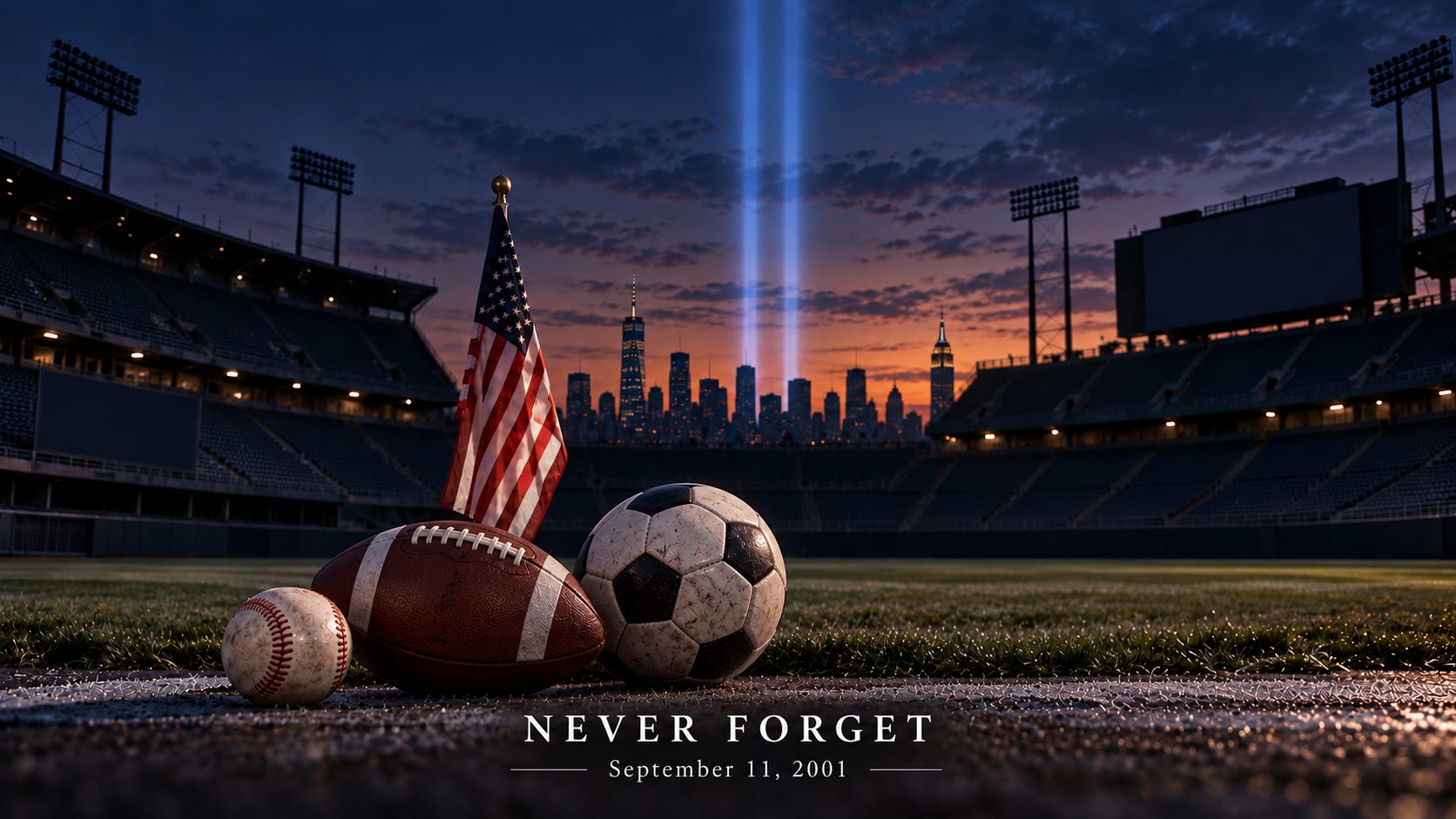
The September 11, 2001 terrorist attacks permanently altered the United States and reached into every part of ordinary American life—including sports. Twenty-five years later, the images, losses and shock of that Tuesday morning remain inseparable from the way a country paused, mourned and eventually tried to gather again.
On September 11, al-Qaeda terrorists hijacked four commercial airliners. Two were flown into the World Trade Center’s Twin Towers in New York, one struck the Pentagon outside Washington, D.C., and a fourth—United Airlines Flight 93—crashed in rural Pennsylvania after passengers fought back against the hijackers. Nearly 3,000 people were killed, and countless survivors, first responders, families and communities were affected by the attacks’ immediate trauma and lasting consequences.
For much of the country, the day began normally. People went to work, children went to school and sports teams prepared for games that night or later that week. Then television broadcasts shifted abruptly from regular programming to live images of smoke pouring from the World Trade Center. As the magnitude of the attacks became clear, the normal rhythms of the day vanished.
Sports, an industry built around schedules, travel, crowds and the expectation that the next game will always be played, stopped almost immediately.
Major League Baseball canceled its entire schedule for September 11. The decision soon became a broader shutdown. MLB postponed games through September 16 and did not resume play until September 17. In all, 91 games were moved, and the lost dates were added to the end of the regular season. That scheduling change had an unusual historical consequence causing the 2001 World Series became the first Fall Classic ever played in November.
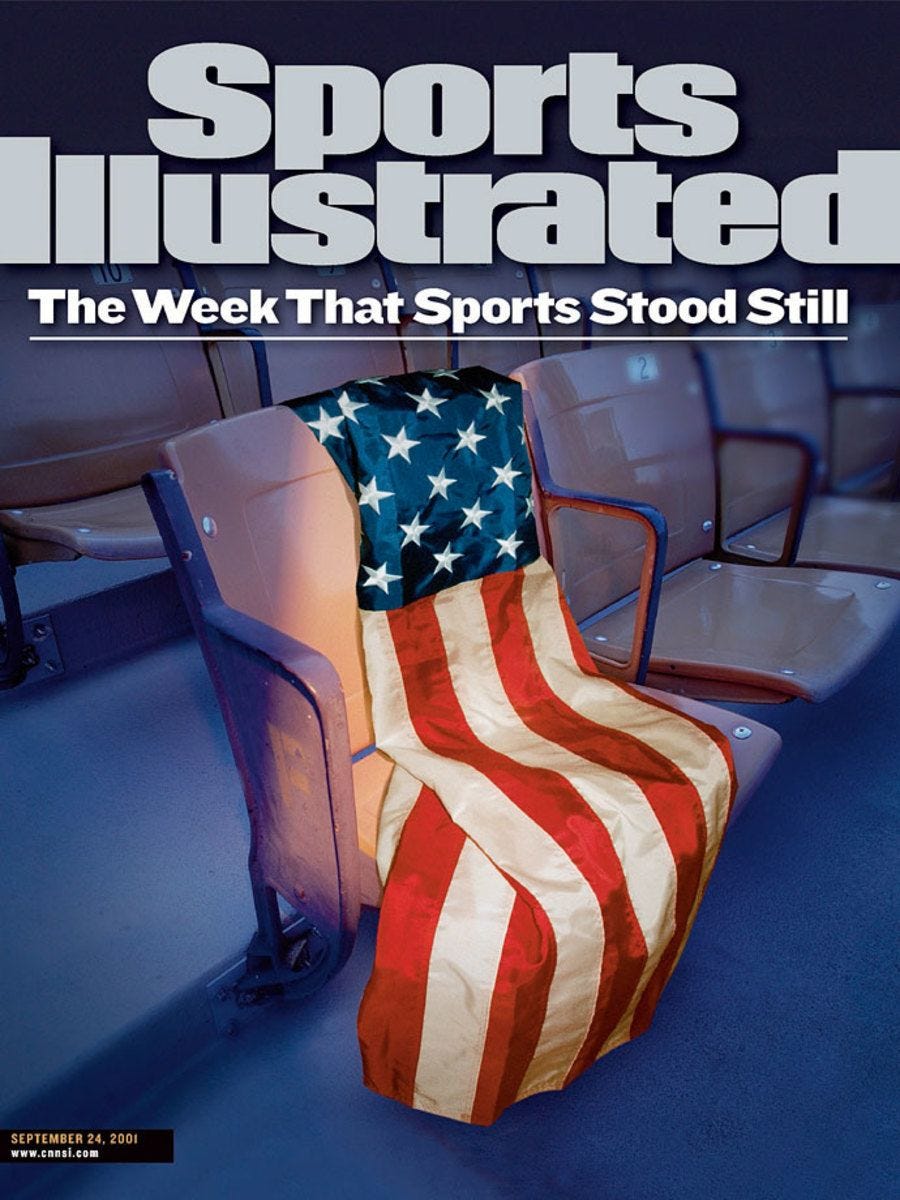
The postponement was about much more than logistics. Air travel had been shut down, security concerns were overwhelming and professional competition felt insignificant beside a national tragedy unfolding in real time. Baseball commissioner Bud Selig cited both security and deep mourning when the first games were called off. The sport had rarely canceled a full day of regular-season games for reasons beyond weather or labor disputes; the previous comparable interruption had come on D-Day in 1944.
The NFL also faced a difficult and emotional decision. Its Week 2 games, scheduled for September 16 and 17, were postponed and eventually moved to the first weekend of January 2002. That pushed the entire postseason back one week and led to Super Bowl XXXVI being played in February—the first Super Bowl held in that month.
The league’s decision carried historical weight. In 1963, the NFL had continued playing games in the days after President John F. Kennedy’s assassination, a choice that remained controversial for decades. In September 2001, commissioner Paul Tagliabue and the league chose a different course cancelling all football games that weekend.
The shutdown extended far beyond baseball and football. College football games were canceled or postponed. Major League Soccer postponed scheduled matches. Minor League Baseball canceled its championship series. NASCAR, golf and other professional and amateur sports also altered or suspended events. Across the country, arenas, ballparks and stadiums—places normally defined by crowds and noise—were suddenly quiet.
When sports returned, they did so in a transformed emotional atmosphere. The games were no longer simply games. Ballparks and stadiums became places for public grieving, patriotic expression and communal support. Moments of silence became standard. Flags were displayed throughout venues. God Bless America was incorporated into many baseball pregame ceremonies, and athletes wore patches, ribbons and other tributes honoring victims, first responders and the country.
In New York, the connection was especially powerful. The Yankees and Mets returned to a city still surrounded by smoke, grief and uncertainty. When the Mets hosted the Atlanta Braves at Shea Stadium on September 21, it was the first major professional sporting event held in New York after the attacks. The game carried an emotional significance far beyond the standings. It gave thousands of people a public place to be together again, even if cheering still felt unfamiliar or complicated.
The most enduring baseball image from that autumn came weeks later. In Game 3 of the World Series at Yankee Stadium, President George W. Bush stood on the mound, threw a ceremonial first pitch and declared to the crowd, I’m feeling pretty good now.” The reaction was thunderous. Whether viewed as a moment of national unity, symbolism or political theater, it reflected the unusual role sports had assumed as a venue where collective emotions could be expressed in public.

The 2001 World Series itself deepened that feeling. The Arizona Diamondbacks and Yankees played memorable late-night games in New York, with the city’s resilience becoming part of the story. The Yankees won dramatic walk-off games in Games 4 and 5 before Arizona ultimately won the series in Game 7. Yet the baseball result felt secondary to the atmosphere around it. The World Series had become part of a larger national attempt to resume familiar rituals without pretending that life was normal.
Here’s the thing, folks: That was perhaps the clearest lesson from sports after 9/11. Athletics did not heal a nation by themselves, and no game could erase the loss suffered by thousands of families. But sports provided a shared language when many people struggled to find words. They offered gathering places, moments of silence, visible tributes and, eventually, the modest comfort of a familiar routine returning.
With that . . . On this anniversary, the central focus remains the people who died, those who responded and the families whose lives were changed forever. The sports world’s response matters because it illustrates how deeply the attacks affected everyday America. For a brief time, scoreboards went dark and competition stopped. When the games returned, they returned with a different purpose: not to distract from what had happened, but to help a grieving country begin moving forward together.
We cannot change the past. So, we can honor those we lost by remembering, standing together, and carrying their spirit forward.
Please visit Binary News where we post regular opinion pieces about including but not limited to business, politics, sports, and technology.